Governance in Chalameria
Governance in Chalameria is not founded upon inheritance or conquest, but upon a carefully maintained balance of merit, equality, equity, and earned status. Authority is granted neither by blood nor by wealth, but through recognition of service and devotion to the well-being of the realm. In this way, Chalameria’s nobility does not stand apart from its people; it rises from them.
All paths of governance begin with recognition. Any citizen, regardless of origin, may be acknowledged for their merit and called toward a noble path. Upon receiving such recognition, an individual becomes known as an Aspirant. From that moment forward, choice defines their future. Some Aspirants elect to proceed, submitting themselves to education in the traditions, ethics, and responsibilities of nobility under the guidance of the Order of Serratura. Alongside this instruction, they are tested by the Order to which they belong, facing trials meant not to reward ambition, but to measure courage, integrity, and the willingness to act for others rather than for oneself. Others, having been recognized, choose not to advance further. There is no shame in this decision. Many find that acknowledgement alone is sufficient, and they return willingly to quieter lives, often entering the bureaucracy where they ensure that the wheels of government, law, and civic life continue to turn smoothly for all.
Those who continue beyond aspiration enter a realm defined by service above self. It is here that governance truly begins.
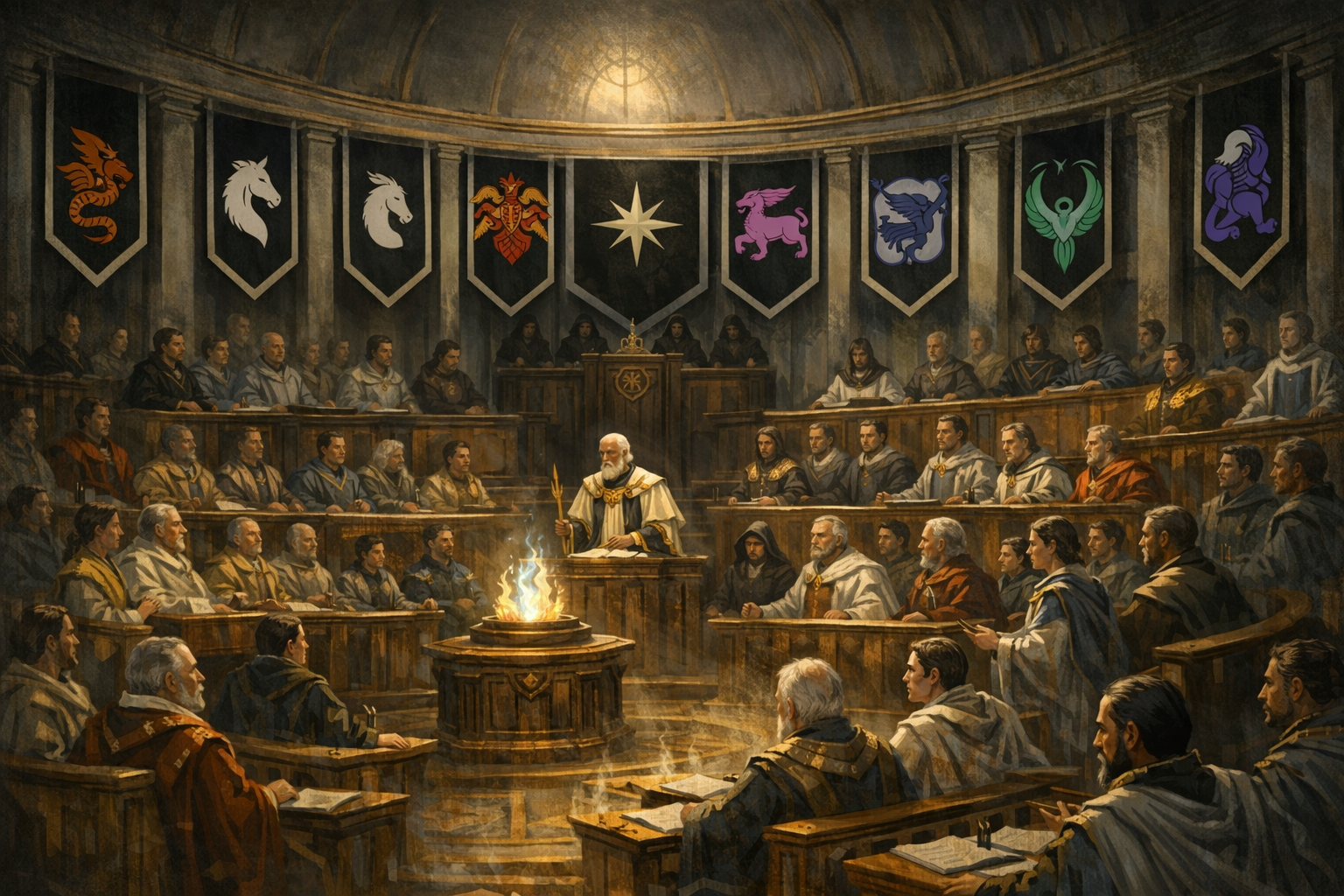
The authority of the realm is exercised through the Concord, which convenes in Maram, the capital of Chalameria. Though Maram stands as a functioning barony in its own right, it is also the political heart of the realm, a place where noble voices gather to shape the future. For the Concord to assemble, a quorum must be present. This quorum requires a minimum of representatives from each of the seven Orders who have voting rights. This, ensuring that no single tradition or philosophy may dominate the proceedings through absence or imbalance as all Orders must be present. At present, seven Orders possess full voting rights, and their representatives form the body that allows governance to proceed. These members are from the Golden Orders of Serratura, Gale, and Jirrah and the Silver Orders of Averin, Istrado, Egaria, and Voskis. The Order of Alarion, still probationary, is granted the right to observe and speak but not to vote, and thus does not count toward quorum.
When quorum is achieved, the gathered nobles are known collectively as the Chalamerian Senate. Any individual who has attained noble rank may attend these sessions. There is no payment for participation, no land granted, no property awarded, and no coin exchanged. Attendance confers only one privilege: the right to speak. This ensures that service in governance remains a burden accepted willingly rather than a reward pursued for gain.
Debate within the Senate is structured to preserve balance and fairness. Every noble may speak on matters brought before the body, but no voice may dominate. Each speaker is granted a fixed and equal span of time, traditionally five minutes in length, ensuring that even the quietest perspective may be heard and the most powerful must speak with discipline and purpose. Over these proceedings presides the Senate Archon, whose duty is not to rule the debate but to maintain its flow, keep time, count votes, organize paperwork, and ensure that order is preserved. The Archonship is held by the Order with the greatest number of active nobles, reflecting influence earned through broad societal support rather than imposed authority.
When debate has run its course, the Archon calls for a vote. No matter how passionate the discussion, no motion advances without both a formal call and the support of another noble. At this point, the Orders withdraw into closed session. Within these private councils, each Order debates internally and determines its stance. An Order cannot act by slim margins; it must reach a clear consensus among its members before casting its will outward. Only when a supermajority within an Order agrees does that Order return to the Senate prepared to vote.
Once the Orders reconvene, their votes are presented openly. Even then, no measure passes easily. Among the Orders themselves, a supermajority is required for a motion to advance. This rule is absolute and intentional, designed to prevent governance by narrow margins and to force compromise between traditions, philosophies, and factions. In Chalameria, unity is not assumed; it is forged.
When a measure finally succeeds, the Archon records the outcome upon an ancient artifact whose origins predate the modern Orders. This relic serves as a conduit, transmitting the decision directly to the inner chambers of the Grand Concord.
The Grand Concord stands as the final authority of the realm, yet it is defined by secrecy rather than spectacle. Its members walk openly among the Senate and debate alongside their peers, their voices carrying no more weight than any other noble. Only when the Senate session is formally concluded do they withdraw, and only then does the Concord truly convene. The chamber in which they meet is sealed, without doors or windows, and what transpires within remains unknown to all outside it. What is known is this: every decision of the Grand Concord emerges as one. All rulings are unanimous, spoken with a single voice, regardless of the disagreements that may have preceded them.
Those who serve upon the Grand Concord are chosen in silence. Within each Order, a blind vote is conducted among peers, and the results are sent beyond mortal scrutiny to the Concord itself. The Concord alone tabulates these votes and notifies the chosen individual by mirror bird. When a member’s service ends, they retain no memory of what transpired within the sealed chamber. Their authority leaves no personal legacy, no claim to prestige, and no mark of power beyond what they had already earned through service.
Even the highest positions in Chalameria are not beyond accountability. Any noble, Baron, Archon, or member of the Grand Concord may be challenged through a vote of no confidence. Such a challenge follows the same rigorous procedures as all other governance, requiring overwhelming agreement both within the Orders and among them. When such a vote succeeds, removal is immediate, regardless of status or station. Authority in Chalameria is not clung to; it is held only so long as it is deserved.
In the end, governance in Chalameria rests upon altruism, merit, and selfless service. It is bound by oaths sworn to the land itself and by reverence for the traditions and memories carried by the Orders. It is a meritocratic parliamentary system in which nobility rises from the citizenry, leaders are chosen by peers, and power exists solely for the betterment of all.
A Schism Within Unity
In the aftermath of Lilah’s banishment and the unmaking of the Dark Prince’s accursed state, the world did not find peace. It broke. Vast earthquakes split cities and valleys alike. Seas raged where none had before, and skies burned with unfamiliar storms. What was first believed to be a catastrophe confined to the Dreamwood soon revealed itself as something far greater. All of Chalameria trembled. The land itself reeled from the weight of unleashed power. It fell to the Grand Concord to act—not as philosophers or lawmakers, but as stewards of survival. They scrambled to stabilize regions shattered by quakes, to redirect resources, to contain famine, and to tend to a staggering loss of life. Old supply lines failed. Ancient wards collapsed. Entire communities vanished into dust or flood. Progress has been made—but the journey forward has been slow, costly, and uncertain. And looming behind all of it remains one unresolved truth: The fate of the Prince.
What was once a unified Concord has now fractured into three distinct visions for Chalameria’s future.
The First Path: The Restorationists
The Restorationists believe that the world broke not because of tradition, but because it was abandoned. To them, Chalameria requires order, lineage, and discipline now more than ever. They argue that the Prince, stripped of corruption, must be restored to the throne as is his rightful due—not as a tyrant reborn, but as a symbol of continuity. Alongside this, they seek to strengthen the Orders, particularly the Order of Serratura. Nobility, in their view, must be earned through rigorous trial, formal education, and deep indoctrination into the philosophies and responsibilities of the Orders. Power and Titles should belong only to those proven capable of wielding it. Without structure, they warn, Chalameria will collapse into chaos once more.
The Second Path: The Breakers of Crown and Chain
This faction believes the opposite: that the world shattered because of kings, Orders, and inherited authority. To them, the Prince and the Orders are relics of a failed age—symbols of hierarchy that concentrated power until it ruptured reality itself. They call for an end to monarchy, nobility, and Orders altogether. No more titles. No more sanctioned authority. No more merit measured by ritual and approval. All people, they argue, should be equal—free to lead by will, character, and action alone. They demand the execution of the Prince, the dissolution of the Concord, and the birth of a new, decentralized order of governance. After all, if a person is truly meritorious, why should they need a title to prove it?
The Third Path: The Accordant Path, The middle road.
Neither blind tradition nor utter dismantling. This faction believes Chalameria can survive only through measured compromise. They advocate for the Prince’s exile—not restoration, not execution—but a path of atonement. He would be sent beyond Chalameria’s borders to confront the remnants of the Akedian Empire: to redeem them, reclaim them, or destroy the threat entirely. At home, they seek reform rather than rupture. They recognize a growing truth among the people: many Chalamerians are weary of bureaucracy, exhausted by the ordeals of Serratura, and frustrated by systems that delay recognition until long after merit has been proven. They desire honor now, earned through service and leadership—not endless trials. And so, pressed by catastrophe and stretched thin by reconstruction, the Grand Concord has begun to experiment.
The Experiment:
New titles—outside the traditional Order structures—are being tested. The position of Reeve is one such innovation. These roles are granted to individuals and families of means, competence, and demonstrated leadership, without requiring full Order induction. If successful, this path could offer a new avenue for recognition and governance—one that bridges authority and accessibility.
If it fails?
Then the Restorationists will claim vindication.
Or the Breakers will say the system is beyond saving.
And Chalameria will be forced to choose—tradition, abolition, or something entirely new. For now, the world watches. And waits.

The Great Shattering and the Time of Forgetting.
Service above self is the foundation of Chalamerian nobility. To select an Order, to swear an oath to the land itself, and to abide by the traditions and memory of that Order is paramount. This principle is the bedrock upon which the entire system of governance rests.
Yet in the aftermath of the Time of Forgetting, and the Great Shattering that followed the removal of Lilah, the world was left broken. Lives hung in the balance. Cities lay in ruin. Vast resources were required to preserve what remained and to rebuild swiftly and efficiently. Faced with this devastation, the Grand Concord and the Chalamerian Senate were given an impossible charge—one that demanded action even at the cost of principle.
In desperation, they chose compromise.
On a case-by-case basis, individuals were permitted to exchange land, coin, and resources for status, peerage, and title. These arrangements were profoundly non-traditional and controversial. Those elevated through this process were not bound to any Order. As such, they were not subject to the guidance, oversight, or traditions of an Order, nor were they granted voting rights within the Senate. They stood adjacent to nobility, but not fully within its ancient framework.
It was a calculated gamble—one rooted in hope rather than certainty. The Concord wagered that the altruism of those who gave would rise above corruption, that generosity would not curdle into entitlement, and that necessity would not erode the soul of governance itself. The resources were accepted. The lives were saved. The titles were granted. In all cases, the recipients were bound to the same traditions, responsibilities, and pathways of service as all nobles of Chalameria, including the right—and the risk—of losing title and status through a vote of no confidence among their peers.
All that remains now is to see whether this compromise strengthens the realm—or whether it proves to be the fracture from which greater failure grows.
OOG Nobility Agreement: Alliance Atlanta LARP
Within Alliance Atlanta LARP, any individual holding an official title—whether In-Game (IG) or Out-of-Game (OOG)—is understood to be a visible representative of the organization. By choosing to pursue and accept a Player Character (PC) noble title IG, you become eligible to receive additional plot, narrative focus, and storylines specific to your title and station. In return, you are expected to uphold the responsibilities and standards outlined below.
Alliance Atlanta commits to working with you as a player to provide avenues for advancement, meaningful opportunities for your title to impact the broader kingdom, and consistent application of standards across all titled PCs. However, holding a noble title also carries expectations beyond personal story advancement. You are required to share the spotlight with others, promote an inclusive and welcoming environment, and avoid behavior that seeks to monopolize plot, exclude fellow players, or diminish their opportunities. Titled PCs are expected to act as stewards of the community—supporting the game space, encouraging engagement, and refraining from actions that limit, undermine, or disparage the experience for others.
This OOG agreement functions as a code of conduct for the player, not as a guide for character behavior. While we do not intend for conflict to arise between in-game roleplay and out-of-game expectations, should such a conflict occur, adherence to this OOG code will take precedence. Acceptance of a noble title signifies agreement to uphold these standards consistently and in good faith.
A lengthy list of specific dos and don’ts would only encourage rules-lawyering and hair-splitting, rather than the good-faith conduct this agreement is meant to foster. Instead, understand that your actions—within the in-game world, the out-of-game community, and even in shared spaces such as Discord—collectively reflect upon both your character and your role within the organization. Disparaging remarks, rumors of bullying, exclusionary behavior, or conduct that undermines others are not representative of the community we aspire to build and maintain. Noble titles are difficult to attain and often take years of dedication, trust, and service to be granted. However, they may be revoked if the holder fails to uphold the standards, expectations, and values of the Alliance Atlanta community.